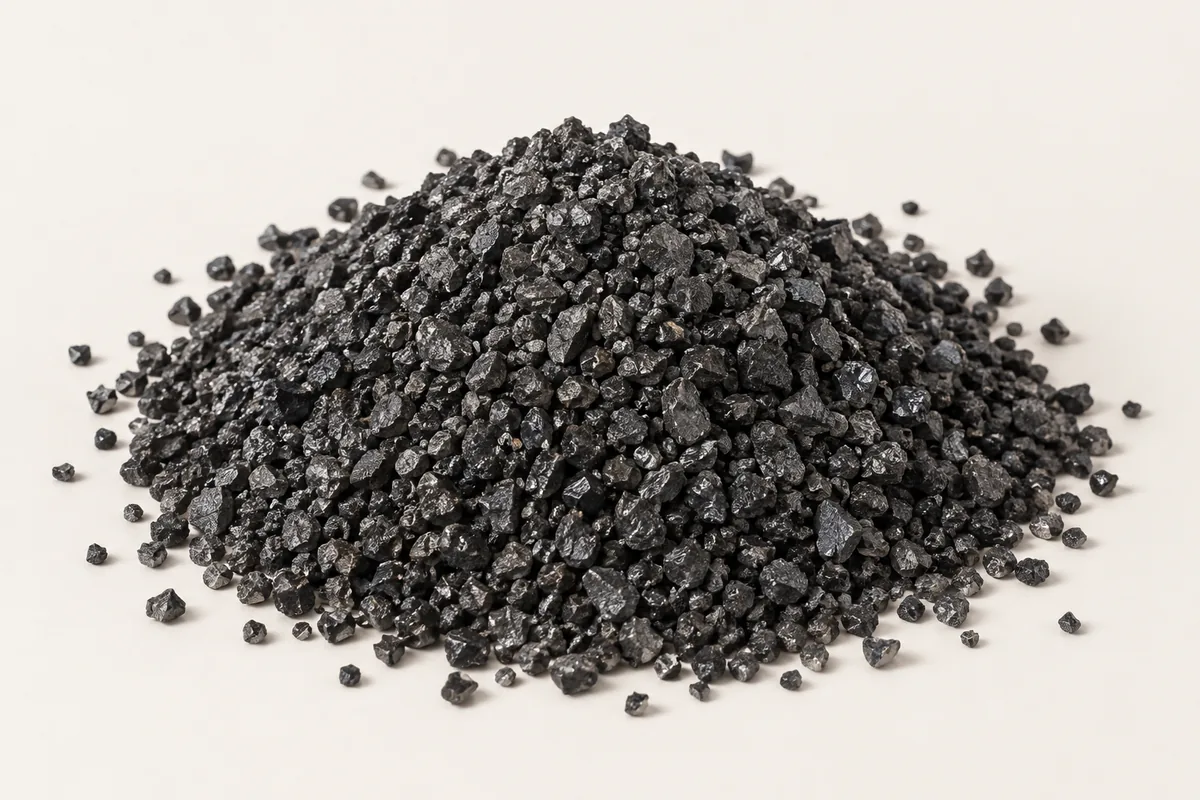
What it is
- Size band
- Nominal 1.4 mm – 4.75 mm as separated. Not yet sieve-tested.
- Shape
- Angular, hard, dry and unwashed.
- Colour
- Black to grey.
- Plant stream
- Screening overs
- Structure
- Amorphous, non-crystalline. The granted US patent covering the material characterises it as greater than 99% amorphous glass.
- Parent specific gravity
- 2.7 – 2.9. This is a dense mineral glass, not a lightweight expanded material with closed internal cells.
- Supplied
- Loose bulk, pickup from Wabash, Indiana
What this kind of material is used for
Coarse inorganic grit in this size range is generally used for the purposes below. We are not publishing comparative performance against perlite, pumice, granite grit or calcined clay, because the tests that would support such a comparison have not been run.
- Drainage and aeration components in growing-media blends
- Topdressing on containers and beds
- Bonsai, cactus, succulent and orchid substrate blends
- Green-roof and engineered-substrate components
- Anti-skid grit where an angular hard particle in this size range is specified
Who buys it
- Potting soil and substrate blenders
- Hydroponic and vertical-farm operators
- Bonsai, succulent, cactus and orchid nurseries
- Green-roof substrate manufacturers
- Municipal and county buyers of winter anti-skid material
Not established yet
One of these is the most important unknown in the whole product line. It is first on the list for that reason.
- No pH or electrical conductivity data. With 25 to 35% calcium oxide in the parent chemistry, a high initial pH is a real possibility. Until a saturated media extract pH and EC with a buffer curve are run, no statement can be made about how this material behaves in a root zone, and no grower should assume it is neutral.
- No air-filled porosity, water-holding capacity or bulk density measurements.
- No seed-germination or phytotoxicity bioassay.
- No comparison against perlite or pumice. Note that at a specific gravity of 2.7 to 2.9 this material is many times denser than perlite, so a price per ton is not comparable to a price per cubic foot.
- No durability or crush testing through wet and dry cycling.
 SecondLife Minerals